427. Construct Quad Tree
Given a n * n matrix grid of 0's and 1's only. We want to represent grid with a Quad-Tree.
Return the root of the Quad-Tree representing grid.
A Quad-Tree is a tree data structure in which each internal node has exactly four children. Besides, each node has two attributes:
val: True if the node represents a grid of 1's or False if the node represents a grid of 0's. Notice that you can assign thevalto True or False whenisLeafis False, and both are accepted in the answer.isLeaf: True if the node is a leaf node on the tree or False if the node has four children.
class Node {
    public boolean val;
    public boolean isLeaf;
    public Node topLeft;
    public Node topRight;
    public Node bottomLeft;
    public Node bottomRight;
}
We can construct a Quad-Tree from a two-dimensional area using the following steps:
- If the current grid has the same value (i.e all
1'sor all0's) setisLeafTrue and setvalto the value of the grid and set the four children to Null and stop. - If the current grid has different values, set
isLeafto False and setvalto any value and divide the current grid into four sub-grids as shown in the photo. - Recurse for each of the children with the proper sub-grid.

If you want to know more about the Quad-Tree, you can refer to the wiki.
Quad-Tree format:
You don't need to read this section for solving the problem. This is only if you want to understand the output format here. The output represents the serialized format of a Quad-Tree using level order traversal, where null signifies a path terminator where no node exists below.
It is very similar to the serialization of the binary tree. The only difference is that the node is represented as a list [isLeaf, val].
If the value of isLeaf or val is True we represent it as 1 in the list [isLeaf, val] and if the value of isLeaf or val is False we represent it as 0.
Example 1:

Input: grid = [[0,1],[1,0]]
Output: [[0,1],[1,0],[1,1],[1,1],[1,0]]
Explanation: The explanation of this example is shown below:
Notice that 0 represents False and 1 represents True in the photo representing the Quad-Tree.
Example 2:
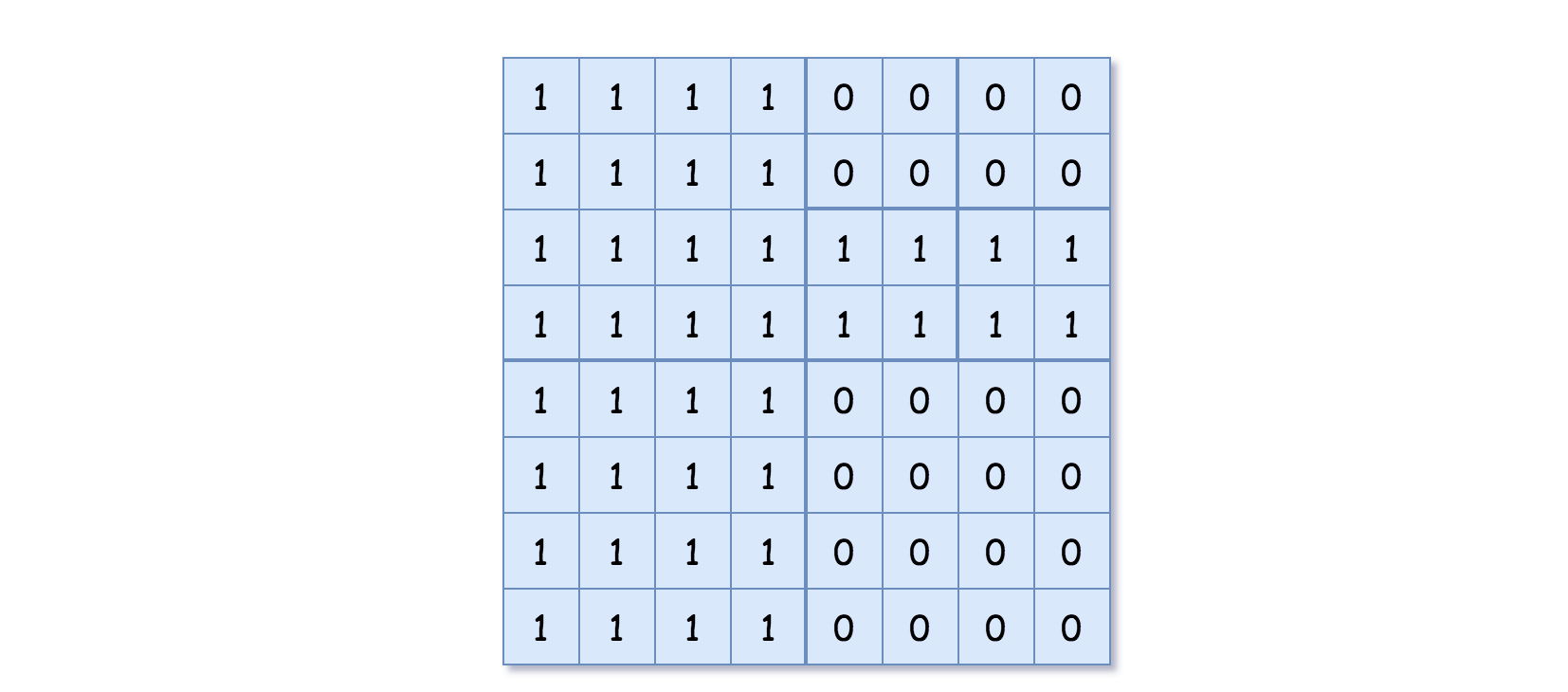
Input: grid = [[1,1,1,1,0,0,0,0],[1,1,1,1,0,0,0,0],[1,1,1,1,1,1,1,1],[1,1,1,1,1,1,1,1],[1,1,1,1,0,0,0,0],[1,1,1,1,0,0,0,0],[1,1,1,1,0,0,0,0],[1,1,1,1,0,0,0,0]]
Output: [[0,1],[1,1],[0,1],[1,1],[1,0],null,null,null,null,[1,0],[1,0],[1,1],[1,1]]
Explanation: All values in the grid are not the same. We divide the grid into four sub-grids.
The topLeft, bottomLeft and bottomRight each has the same value.
The topRight have different values so we divide it into 4 sub-grids where each has the same value.
Explanation is shown in the photo below:
Constraints:
n == grid.length == grid[i].lengthn == 2xwhere0 <= x <= 6
Solution:
/*
// Definition for a QuadTree node.
class Node {
    public boolean val;
    public boolean isLeaf;
    public Node topLeft;
    public Node topRight;
    public Node bottomLeft;
    public Node bottomRight;


    public Node() {
        this.val = false;
        this.isLeaf = false;
        this.topLeft = null;
        this.topRight = null;
        this.bottomLeft = null;
        this.bottomRight = null;
    }

    public Node(boolean val, boolean isLeaf) {
        this.val = val;
        this.isLeaf = isLeaf;
        this.topLeft = null;
        this.topRight = null;
        this.bottomLeft = null;
        this.bottomRight = null;
    }

    public Node(boolean val, boolean isLeaf, Node topLeft, Node topRight, Node bottomLeft, Node bottomRight) {
        this.val = val;
        this.isLeaf = isLeaf;
        this.topLeft = topLeft;
        this.topRight = topRight;
        this.bottomLeft = bottomLeft;
        this.bottomRight = bottomRight;
    }
}
*/

class Solution {
    public Node construct(int[][] grid) {
        return build(grid, 0, 0, grid.length);
    }

    private Node build(int[][] grid, int row, int col, int size){
        if (isSame(grid, row, col, size)){ // TC: O(n^2)
            return new Node(grid[row][col] == 1, true);
        }


        int half = size / 2;

        Node topLeft = build(grid, row, col, half);

        Node topRight = build(grid, row, col + half, half);

        Node bottomLeft = build(grid, row + half, col, half);

        Node bottomRight = build(grid, row + half, col + half, half);

        return new Node(true, false, topLeft, topRight, bottomLeft, bottomRight);

    }

    private boolean isSame(int[][] grid, int row, int col, int size){ // O(n^2)
        int value = grid[row][col];

        for (int i = row; i < row + size; i++){
            for (int j = col; j < col + size; j++){
                if (grid[i][j] != value){
                    return false;
                }
            }
        }

        return true;
    }


}

// TC: O(n^2logn)
// SC: O(n^2)