104. Maximum Depth of Binary Tree
Given the root of a binary tree, return its maximum depth.
A binary tree's maximum depth is the number of nodes along the longest path from the root node down to the farthest leaf node.
Example 1:

Example 2:
Solution:
/**
 * Definition for a binary tree node.
 * public class TreeNode {
 *     int val;
 *     TreeNode left;
 *     TreeNode right;
 *     TreeNode() {}
 *     TreeNode(int val) { this.val = val; }
 *     TreeNode(int val, TreeNode left, TreeNode right) {
 *         this.val = val;
 *         this.left = left;
 *         this.right = right;
 *     }
 * }
 */
class Solution {
    public int maxDepth(TreeNode root) {
       if (root == null){
        return 0;
       }

       int leftMaxDepth = maxDepth(root.left);
       int rightMaxDepth = maxDepth(root.right);

       return Math.max(leftMaxDepth, rightMaxDepth) + 1;
    }
}

// TC: O(n)
// SC: O(n)
递归用的是栈空间.
二叉树与递归recursion
- 如何思考二叉树相关问题?
- 为什么需要使用递归?
- 为什么这样写就一定能算出正确答案?
- 计算机是怎么执行递归的?
- 另一种递归思路
Recursion (Down-Top)
/**
 * Definition for a binary tree node.
 * public class TreeNode {
 *     int val;
 *     TreeNode left;
 *     TreeNode right;
 *     TreeNode() {}
 *     TreeNode(int val) { this.val = val; }
 *     TreeNode(int val, TreeNode left, TreeNode right) {
 *         this.val = val;
 *         this.left = left;
 *         this.right = right;
 *     }
 * }
 */
class Solution {
    public int maxDepth(TreeNode root) {
        if (root == null){
            return 0;
        }
        int left = maxDepth(root.left);
        int right = maxDepth(root.right);

        return Math.max(left, right) + 1;
    }
}
// TC: O(n)
// SC: O(n)
/**
 * Definition for a binary tree node.
 * public class TreeNode {
 *     int val;
 *     TreeNode left;
 *     TreeNode right;
 *     TreeNode() {}
 *     TreeNode(int val) { this.val = val; }
 *     TreeNode(int val, TreeNode left, TreeNode right) {
 *         this.val = val;
 *         this.left = left;
 *         this.right = right;
 *     }
 * }
 */
class Solution {
    public int maxDepth(TreeNode root) {
        if (root == null){
            return 0;
        }

        int left = maxDepth(root.left) + 1;
        int right = maxDepth(root.right) + 1;
        return Math.max(left, right);
    }
}
Complexity analysis
- Time complexity : we visit each node exactly once, thus the time complexity is \(O(N)\), where \(N\) is the number of nodes.
- Space complexity : in the worst case, the tree is completely unbalanced, e.g. each node has only left child node, the recursion call would occur \(N\) times (the height of the tree), therefore the storage to keep the call stack would be \(O(N)\). But in the best case (the tree is completely balanced), the height of the tree would be \(log(N)\). Therefore, the space complexity in this case would be \(O(log(N))\).
graph TD;
3@{ shape: circle, lable: "1"}
9@{ shape: circle, label: "9"}
20@{ shape: circle, label: "20"}
15@{ shape: circle, label: "15"}
7@{ shape: circle, label: "7"}
3-->9
3-->20
20-->15
20-->7
不要一开始就陷入细节, 而是思考整棵树与其左右子树的关系
整棵树的最大深度 = max(左子树的最大深度, 右子树的最大深度) + 1
graph TD;
3@{ shape: circle, label: "3"}
9@{ shape: tri, label: "..."}
20@{ shape: tri, label: "..."}
3-->9
3-->20
原问题: 计算整棵树的最大深度
子问题: 计算左/右子树的最大深度
子问题和原问题是相似的
类比循环, 执行的代码也应该是相同的, 但子问题需要把计算结果返回给上一级问题这更适合用递归实现.
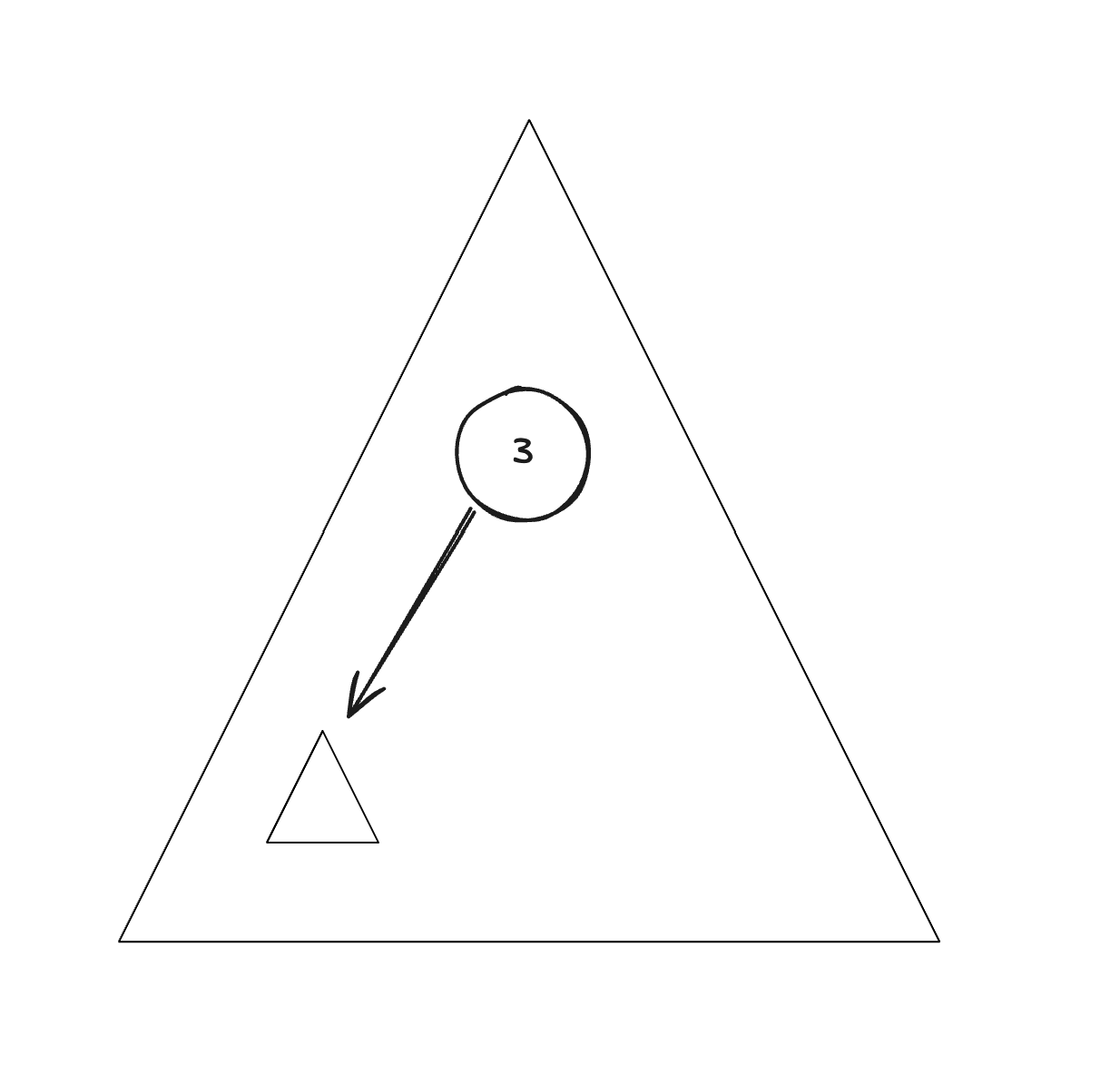
由于子问题的规模比原问题小, 不断递下去, 总会有个尽头, 即递归的边界条件(base case), 直接返回它的答案(归).

最简单和常见的数学归纳法是证明当n等于任意一个自然数时某命题成立. 证明分下面两步:
-
证明“当n=1时命题成立", (选择数字1因其作为自然数集合中中最小值)
-
证明, “若假设在n=m时命题成立, 可推导出在n=m+1时命题成立. (m代表任意自然数)
Top-Down
/**
 * Definition for a binary tree node.
 * public class TreeNode {
 *     int val;
 *     TreeNode left;
 *     TreeNode right;
 *     TreeNode() {}
 *     TreeNode(int val) { this.val = val; }
 *     TreeNode(int val, TreeNode left, TreeNode right) {
 *         this.val = val;
 *         this.left = left;
 *         this.right = right;
 *     }
 * }
 */
class Solution {
    public int result;
    public int maxDepth(TreeNode root) {
        result = 0;
        dfs(root, 0);
        return result;
    }

    private void dfs(TreeNode root, int depth){
        if (root == null){
            return;
        }

        depth++;
        result = Math.max(result, depth);
        dfs(root.left, depth);
        dfs(root.right, depth);
    }
}

// TC: O(n)
// SC: O(n)
- 时间复杂度:O(n),其中 n 为二叉树的节点个数。
- 空间复杂度:O(n)。最坏情况下,二叉树退化成一条链,递归需要 O(n) 的栈空间。